

Disclaimer
Content on this page of topcolleges.com is computer generated and therefore is not guaranteed to be 100 percent accurate about various aspects of the education sector. On balance, however, many students and families seek general information about high schools, colleges and universities, graduate programs, testing, education and career planning, and job placement before beginning one-on-one admissions counseling tailored to their specific needs.
What makes an MA or MS application persuasive isn’t necessarily the longest résumé. It’s a clear case for fit. Choosing a degree and assembling materials can feel uncertain when programs differ in focus, requirements, and expectations. Effective MA MS program admissions help starts by connecting your goals to suitable programs, then shaping your experience into a coherent application.
Strong grades and thoughtful writing matter, but applicants also need to show how their academic or professional background supports their next steps and reasons for applying. Advice about tests, statements, recommendations, and deadlines can vary, too. A checklist alone won’t resolve these questions. A deliberate strategy can.
This guide explains how to assess MA and MS program fit, identify the application components that deserve attention, and plan around each program’s requirements. You’ll learn how to build a focused narrative across your materials and prepare for submission. Top Colleges offers personalized graduate admissions counseling to help applicants reflect on their direction and align program choices with a purposeful application strategy.
Key Takeaways
- Compare the academic approach behind each MA or MS, rather than relying on the degree title alone.
- Use each program’s published requirements to guide your checklist, and make sure your transcripts, experience, writing, and recommendations support a consistent application story.
- Separate confirmed program details, such as curriculum and admissions expectations, from your own preferences and assumptions.
- Build a program-by-program timeline for shortlisting, preparing materials, coordinating recommendations, submitting, and tracking applications.
- MA MS program admissions help can bring structure to program analysis and application planning while keeping your academic direction at the center.
MA or MS Program Admissions: Start With the Degree That Fits Your Goals
It’s reasonable to hesitate when programs in the same field use different degree titles, or when the same title covers very different kinds of study. MA and MS labels can offer a broad clue about academic emphasis, but they aren’t a substitute for examining the program itself. Start with the Master’s degree as a broad category, then look closely at each department’s curriculum and expectations.
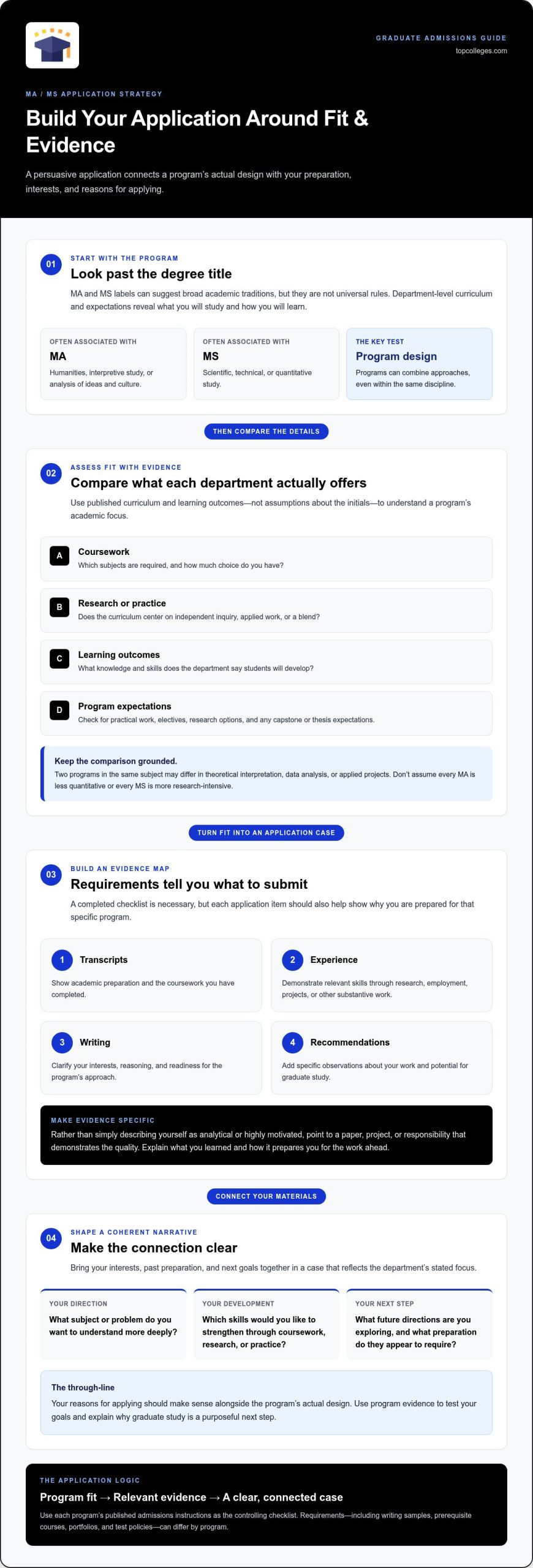
A degree title may signal an academic tradition, but the program design determines what you’ll study and how you’ll learn. An MA commonly emphasizes humanities, interpretive study, or analysis of ideas and culture. An MS commonly emphasizes scientific, technical, or quantitative study. These are general patterns, not universal rules. Programs can combine approaches, and the same discipline may offer both degrees with different course plans.
What can an MA or MS degree signal?
Look beyond the initials to see how a department puts its academic focus into practice. Compare required courses, electives, research options, practical work, and any capstone or thesis expectations. For example, two programs in the same subject may differ in their emphasis on theoretical interpretation, data analysis, or applied projects. The program details, not assumptions about the title, reveal the difference.
- Coursework: Which subjects are required, and how much choice do you have?
- Research or practice: Does the curriculum center on independent inquiry, applied work, or a blend?
- Learning outcomes: What knowledge and skills does the department say students will develop?
Use published curriculum and learning outcomes to compare programs on their own terms. Don’t assume every MA is less quantitative or every MS is more research-intensive. Department-level design often says more about those expectations than the degree label.
How should your goals shape the degree search?
Start with what you want graduate study to help you investigate or develop. A focused academic motivation is more useful than a general wish to continue studying because it gives you criteria for judging program fit. You don’t need to know every step of your future, but you should be able to identify the questions, skills, or direction that make further study meaningful now.
- What subject or problem do you want to understand more deeply?
- Which skills would you like to strengthen through coursework, research, or practice?
- What future directions are you exploring, and what preparation do they appear to require?
Test your answers against program evidence. If you want stronger quantitative preparation, examine course sequences and stated learning outcomes. If you’re drawn to interpretive inquiry, look at the subjects and research approaches the department describes. These details can sharpen your shortlist without promising a particular career result.
Effective MA MS program admissions help begins with this alignment: your reasons for applying should make sense alongside the program’s actual design. That clarity gives you a more informed basis for comparing options and explaining why a particular program is a purposeful next step.
Build an MA or MS Application Around Evidence, Not Just Requirements
A completed checklist is necessary, but it doesn’t explain why you’re prepared for a particular program. Each application should make a clear case: your interests fit the department’s focus, your past work shows relevant preparation, and your next goals give graduate study a purpose. The strongest evidence depends on what the program values, so use its published admissions instructions as your controlling checklist.
Requirements can differ even between programs with similar titles. One may request a writing sample, while another may emphasize a quantitative background, portfolio, or prerequisite courses. Test policies vary as well. Some programs require or recommend the GRE; others make it optional or don’t request scores. Verify each program’s current instructions instead of treating a test score as a universal application component.
Build an evidence map for each program. Record what it asks for, what each application item can demonstrate, and where your experience supports your case. For an MA, relevant evidence might include analytical writing or sustained work with a subject the program explores. For an MS, it might include quantitative coursework, technical projects, or research experience, if those match the program’s stated focus. These are examples, not fixed rules.
- Transcripts show your academic preparation and the coursework you’ve completed.
- Experience can demonstrate relevant skills through research, employment, projects, or other substantive work.
- Writing can clarify your interests, reasoning, and readiness for the program’s approach.
- Recommendations can add specific observations about your work and potential for graduate study.
Evidence is stronger than assertion. Instead of describing yourself as analytical or highly motivated, point to a paper, project, or responsibility that demonstrates the quality. Explain what the experience taught you and how it prepares you for the work ahead, without claiming that one achievement guarantees future performance.
How to shape a focused statement of purpose
Connect your academic interests to identifiable program features, such as the curriculum, faculty expertise, or stated focus. Use specific experiences to show how those interests developed and what preparation you bring. A credible career aim doesn’t need to be elaborate. It should explain why this course of study makes sense for the direction you’re exploring.
Keep the statement selective. A list of accomplishments can’t replace a reasoned account of fit. Choose examples that demonstrate preparation for the program’s actual academic approach, whether it involves interpretive inquiry, technical analysis, or a combination. Help the reader follow the logic from your past experience to your proposed study.
How recommendations and records support your case
Choose recommenders who can discuss your relevant academic or professional work in detail, not simply people with impressive titles. Give them context well before submission: your goals, the program’s focus, and the qualities or experience its application asks them to address. This helps their perspective complement your statement instead of repeating it.
Follow each program’s instructions for transcripts, résumé or CV, writing samples, and other materials. Present your records accurately and make relevant experience easy to understand. MA MS program admissions help can support this alignment. Personalized graduate admissions counseling can help connect program analysis with a focused application narrative.
Compare MA and MS Programs by Fit, Curriculum, and Admissions Expectations
A useful comparison goes beyond asking whether a program offers an MA or an MS. Put each option through the same set of questions, then record what the department states separately from what you personally prefer. This distinction keeps assumptions from becoming “facts” as you narrow your choices.
Program fit is strongest when an applicant’s interests match documented program features. Use official program materials to complete a comparison like this:
| Comparison area | Program evidence to record | Your assessment |
|---|---|---|
| Academic focus | Department description, stated learning outcomes, and areas of emphasis | Which topics or questions connect to your interests? |
| Curriculum | Required courses, electives, concentrations, and course descriptions | Which skills or subjects do you want to develop? |
| Research or practice | Research options, practica, projects, and culminating work, where listed | Which learning approach best supports your aims? |
| Admissions expectations | Published prerequisites, application materials, test policies, and submission instructions | What evidence can you provide for the stated expectations? |
Keep the columns distinct. A course requirement is a verifiable fact; preferring a smaller selection of electives is a personal preference. A published research opportunity is evidence; assuming you’ll work with a particular faculty member without program information is speculation. This approach makes comparisons more accurate and helps you explain your choices clearly.
Which program details deserve close comparison?
Read course descriptions, not just course titles. A class with a broad label may cover different material across departments. Review concentrations, research options, practica, and culminating work where the program describes them. Faculty interests can help you assess alignment when official information connects them to the program, but they shouldn’t replace evidence about the curriculum or admissions process.
Check each program’s application instructions for required materials, test policies, and submission procedures. Requirements can differ across departments, including within the same institution, so don’t assume one program’s checklist applies to another. Record the source and date you reviewed it, then revisit the official instructions as you prepare to apply.
How can applicants assess a realistic academic match?
Map your preparation to the program’s stated expectations. If the curriculum emphasizes analytical writing, identify relevant coursework or projects. If it calls for quantitative preparation, note applicable classes or experience. Where you see a gap, be candid. Describe steps you’ve taken to address it without overstating what those steps demonstrate.
Rankings can be one reference point, but they can’t tell you whether a course sequence, learning approach, or academic focus suits your goals. Selectivity and degree initials are not standalone measures of fit either. Strong MA MS program admissions help turns program research into a grounded comparison, so your shortlist reflects documented features and your priorities, not prestige alone.
Create a Practical MA or MS Admissions Plan Without Missing Requirements
Applying to several programs means coordinating different instructions, materials, and deadlines. A generic checklist can hide important differences. Track each program individually, then move from research to submission in a deliberate sequence. Leave time for drafting, revision, recommender coordination, and document checks, since application calendars can differ.
- Shortlist programs. Keep options that align with your academic interests and the preparation you’re seeking. Save each program’s official admissions page so you can return to the source.
- Verify requirements. For every program, note its official deadline, required materials, test policy, submission instructions, and any program-specific components. Don’t assume requirements are shared across departments or institutions.
- Plan your materials. Map each required item to the work involved: statement drafting, résumé updates, transcripts, writing samples, or other requested materials. Set personal checkpoints for drafting, revision, and final review based on the official deadline.
- Coordinate recommendations. Identify recommenders who can discuss relevant work, share program context and submission instructions, and track whether each recommendation has been received.
- Submit and track. Review the application against the program’s instructions, submit through its stated process, and monitor the application status for updates or requests.
How to organize a multi-program application calendar
Create one row per program in a spreadsheet or planning document. A shared calendar can help with reminders, but the institution’s instructions remain authoritative if a date or requirement changes. Make your tracker detailed enough to distinguish applications at a glance.
- Official deadline and link to the program’s admissions instructions
- Required components and any program-specific materials
- Statement version, transcript status, and recommendation progress
- Personal drafting, revision, and document-check milestones
Use progress checks to spot unfinished items before the final review. Your milestones are planning tools, not substitutes for official deadlines. Record the dates published for each program rather than relying on a universal application calendar.
What to check before submitting an application
A careful final review can catch errors in an otherwise thoughtful application. Review each application separately, even if you’re reusing some materials. Confirm that every document and entry follows the specific program’s instructions.
- Check names, dates, required fields, document formats, and uploaded files.
- Confirm the statement names the correct program and gives a tailored reason for applying.
- Review the application status after submission and follow institutional directions if materials are missing.
This structure turns MA MS program admissions help into a practical system: clear priorities, visible progress, and fewer assumptions about what each application requires. Personalized graduate admissions counseling can help you connect program analysis with a manageable preparation plan.
Get Personalized MA or MS Program Admissions Help With Top Colleges
Choosing graduate programs and preparing applications takes more than assembling documents. You need a strategy that reflects your academic direction, compares program details carefully, and presents your experience with purpose. Top Colleges offers personalized graduate admissions counseling to help applicants connect their goals, program analysis, and application materials through practical, self-reflective education planning.
Steven Roy Goodman, Top Colleges’ founder and primary consultant, is an Educational Consultant and Admissions Strategist with an MS and JD. His approach focuses on clarifying what you want to study, examining how specific programs are designed, and considering how your academic and professional experiences support your application. The aim is not admission at any cost. It is to identify programs that make sense for you and prepare a focused application for each.
A student at Harvard University’s Kennedy School of Government credited Goodman with program analysis and admissions support. Guidance can be useful when programs look similar on paper but differ in curriculum, emphasis, and application expectations.
What individualized admissions strategy can help clarify
Personalized MA MS program admissions help can bring your program research and application narrative into alignment. Rather than treating each component as a separate task, counseling can help you consider how your goals, preparation, and chosen programs fit together. Support can include:
- Program analysis to assess how a program’s focus and structure relate to your aims.
- Personal statement review to refine the connection between your interests, experience, and reasons for applying.
- Portfolio development and interview preparation to help organize and communicate relevant work and ideas where applicable.
This process starts with reflection, not a template. For example, if you’re considering programs with different academic approaches, identify which curriculum better supports the questions or skills you want to pursue. Then shape your application around evidence of your preparation for that path. Each program’s official instructions guide its required materials and submission process.
How to take the next step with Top Colleges
Explore how Top Colleges’ graduate admissions counseling can support your planning. The work is centered on the individual: clarifying academic aims, evaluating program fit, and organizing materials into a coherent case for graduate study. No admissions result can be guaranteed, but a thoughtful strategy can help you approach each application with greater direction and care.
Move Forward With a Clearer Graduate Study Direction
You don’t need to make every decision at once. Start by turning what you’ve learned about your interests into a clearer idea of the graduate experience you want. Ask what you hope to understand, create, or contribute through your studies, then use that answer to guide your next choices.
A thoughtful MA MS program admissions help strategy can make the process feel less like a race to submit and more like a considered investment in your academic direction. The goal is not simply to complete applications, but to pursue a program whose approach and expectations make sense for you. That clarity can help you move forward with purpose, even when the decision feels significant.
Give yourself room to make informed choices and prepare with care. Your next chapter starts with a direction you can explain and believe in.
Frequently Asked Questions
Do MA and MS programs have different admissions requirements?
Yes, but requirements are set by each institution and department, not reliably by MA or MS initials. Two programs in the same field may request different prerequisite coursework or writing samples. Build a separate checklist from each program’s current official instructions, and distinguish university-wide rules from department-specific requirements. If an instruction is unclear, follow the institution’s official admissions guidance rather than carrying assumptions over from another program.
Do all MA and MS programs require the GRE?
No. GRE policies vary by institution, department, and application cycle. A program may require scores, accept them optionally, or not request them. Before deciding whether to take the test, identify the current policy for every program on your shortlist and note whether submitted scores are considered. Don’t assume a policy at one university applies elsewhere, even if the programs share a discipline or degree title.
Can I apply to both MA and MS programs in the same field?
Yes, if both programs suit your interests and the kind of study you want to pursue. You can draw on shared experiences, such as a research project, while explaining your distinct reasons for applying to each. One program’s curriculum might align with your interest in interpretation, while another’s stated focus supports a technical direction. Tailor each application to the program instead of sending identical materials.
How important is GPA for MA or MS admissions?
GPA is part of your academic record, but its significance depends on each program’s published criteria and the rest of your application. Review any stated minimums and prerequisites first. Then consider how your transcript reflects preparation for the subject, including relevant courses and changes in your academic performance over time. Don’t treat a particular GPA as a guarantee of admission or proof that applying is pointless.
Do graduate programs require a statement of purpose?
Some programs request a statement of purpose, personal statement, or another written response. The prompt determines what belongs in it, so read the wording carefully before drafting. If it asks why you’re applying, address that directly. If it asks about an experience, explain its relevance rather than repeating your résumé. Check for a word limit, format instructions, and separate essay prompts so your response answers the actual request.
When should I start preparing MA or MS applications?
Start when you’re seriously considering programs and can research their application cycles and materials. There isn’t one preparation calendar for every applicant because deadlines and required components differ. Work backward from each program’s official deadline, allowing time for tasks that depend on others, such as recommendation letters or transcript requests, as well as writing and review. If you’re considering several programs, begin with the earliest deadline you verify.
Can international students get MA or MS admissions guidance?
Yes. Top Colleges provides guidance to international students on admissions and related concerns, including finances, housing, immigration, and social issues. In addition, services like Education and Training offer personalized guidance for applicants navigating UK and international higher education pathways. For MA MS program admissions help, counseling can help you organize questions and connect your goals with program research and application planning. List the institutions you’re considering and the questions you need to resolve about each, then use official university instructions for program-specific processes.