

Disclaimer
Content on this page of topcolleges.com is computer generated and therefore is not guaranteed to be 100 percent accurate about various aspects of the education sector. On balance, however, many students and families seek general information about high schools, colleges and universities, graduate programs, testing, education and career planning, and job placement before beginning one-on-one admissions counseling tailored to their specific needs.
Yes, you can reapply to college after a gap year. Most colleges let rejected applicants apply again for a later term, and a previous rejection typically doesn’t hurt your chances on its own. The key question is whether your new application shows meaningful change. If your profile is essentially the same, you may get the same result.
If you’ve already been admitted, you may be able to defer enrollment and start college later, depending on the school’s policy. You might be weighing whether to hold your place, apply again, or keep other options open. The right choice depends on what has changed since your original application and what you want from the year ahead.
This guide explains how deferral differs from reapplying, what can strengthen a new application, and how to weigh alternatives, including when you’re considering highly selective colleges. You’ll have a clearer framework for making your gap year a deliberate next step rather than simply repeating last year’s process.
Key Takeaways
- Identify what has materially changed since your last application before deciding to apply again.
- Use your time away to document meaningful activities and keep academic skills fresh.
- Compare the security of deferred admission with the flexibility and financial implications of applying again.
- Keep alternative college plans open while reviewing each school’s policies and application requirements.
- For highly selective colleges, build a clear case for how your gap-year experiences strengthen your application.
Does a Rejection Hurt Your Chances When Applying Again?
A previous rejection usually doesn’t reduce your chances on its own, but submitting essentially the same application may lead to the same outcome. Treat your next application as a new case, supported by clear evidence of change.
You may be able to use earlier essays and recommendation letters as starting points, but revise essays for each college and update recommendations when possible. Colleges may require refreshed materials, so review each application’s instructions before submitting.
-
Assess the Effect of a Prior Rejection
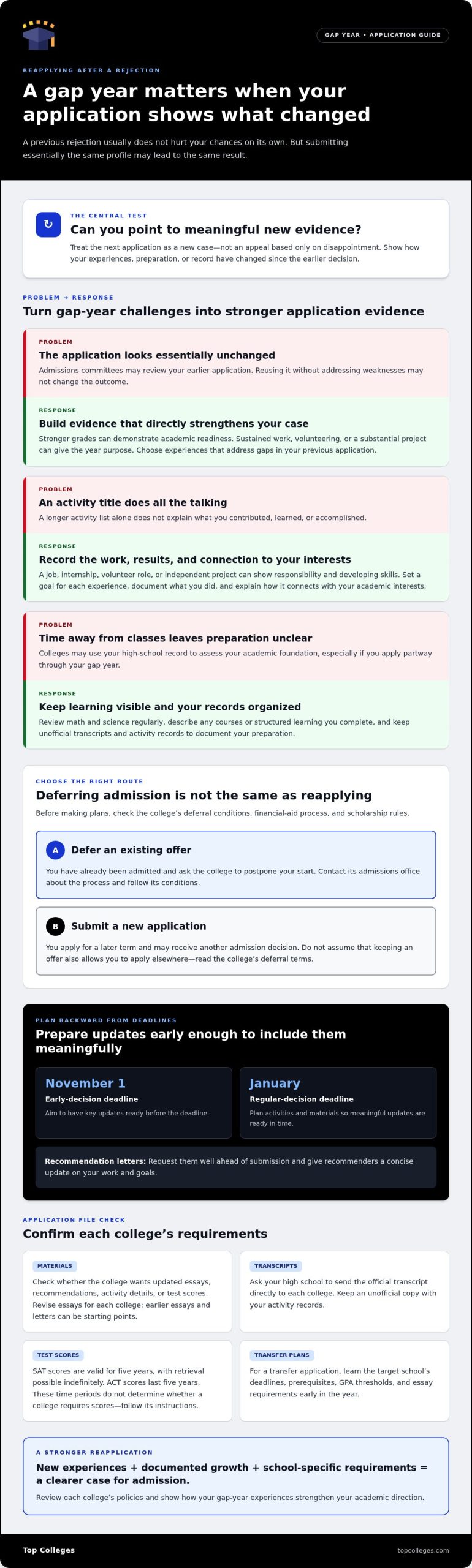
Review your previous application and identify what has changed since the admission decision. Most colleges let rejected applicants apply for a later term, but admissions committees may review the earlier application. Submitting essentially the same profile may not change the result. Don’t treat a new application as an appeal based only on disappointment. Make a stronger case by presenting meaningful new evidence or directly addressing a weakness.
-
Build New Application Evidence
Choose experiences that address gaps in your previous application, then keep track of what you accomplish and learn. Stronger grades can demonstrate academic readiness; sustained work, volunteering, or a substantial project can give your gap year purpose. If limited academic preparation contributed to the rejection, use the year to strengthen your record before applying again. The goal is a stronger application, not simply a longer activity list.
- Distinguish deferred admission from a new application before choosing your route. With deferred admission, you’ve already been admitted and ask the college to postpone your start. Contact its admissions office about the process. Reapplying means submitting a new application for a later term, with the possibility of another decision. A gap year can support either plan, but don’t assume that holding an admission offer also lets you apply elsewhere. Read the college’s deferral conditions and follow them.
- Build your activity and deadline timeline backward from each college’s application date. New experiences must be complete early enough to appear meaningfully in your materials: aim to have key updates ready before the November 1 early-decision deadline or the January regular-decision deadline. Request recommendation letters well ahead of submission, and give recommenders a concise update on your work and goals. For a transfer application, learn the target school’s deadlines, prerequisites, GPA thresholds, and essay requirements early in the year. Plan coursework and recommendations around those criteria, not around first-year application assumptions.
Can you apply to college after a gap year?
Yes, you can apply during or after a gap year. SAT or ACT scores don’t automatically need to be resubmitted; follow each college’s requirements.
-
Address Time Away From Coursework
Explain how you’ll stay prepared for college-level work while away from high school. Admissions officers may use your high-school record to assess your academic foundation, especially if you apply partway through your gap year. Review math and science regularly, and describe any courses or structured learning you complete. Keep unofficial transcripts and activity records organized to document your preparation.
-
Strengthen the Existing Admissions Profile
Choose gap-year activities that add substance to your application. A job, internship, volunteer role, or independent project can show responsibility and developing skills. Set a clear goal for each experience, then record your work and results for future applications. Don’t rely on activity titles alone. Explain what you contributed and how the experience connects with your academic interests.
-
Check Admissions Requirements and Deadlines
Review each school’s application requirements before preparing materials. Colleges don’t necessarily require different materials just because you took a gap year, but they may request updated recommendation letters, activity details, test scores, or essays. Ask your high school to send the official transcript directly to each college, and keep an unofficial copy for your records. Create a calendar for application deadlines and recommendation requests.
-
Check Whether Test Scores Must Be Resent
Follow each college’s score-submission instructions for your new application. SAT scores are valid for five years, with retrieval possible indefinitely; ACT scores last five years. These time periods don’t determine whether a particular school requires scores, so follow its application requirements. Keep your test records with transcripts and activity details for a complete application file.
- Decide whether you’re submitting a new application or delaying an existing admission offer. If a college has already admitted you, contact its admissions office about arranging a delayed start before making plans. The University of the Pacific says students aren’t penalized for taking a gap year when they apply. Its policy treats gap-year applicants as first-year students and evaluates them like students applying during high school.
When reapplying to college after a gap year, a clear plan can help you connect new experiences with your academic direction. For support shaping that plan, explore college admissions counseling.
Deferring enrollment versus reapplying
Choose between keeping an existing admission offer and submitting a new application. Before deciding, compare the college’s deferral conditions, financial aid process, and scholarship rules.
- Ask the college about deferral before declining your place. Deferred admission means you’ve been admitted and postpone your start, often for a year. Reapplying means seeking admission for a later term through a new application. The distinction shapes your next steps. For example, if you have an offer, find out whether the college will hold your place during a gap year and what conditions apply.
- Clarify what your deferral permits before making plans. Some college policies let students apply elsewhere while holding a deferred place; others may restrict it. Don’t assume you can keep an offer and submit other applications at the same time. Get the policy in writing, then compare its terms with your academic plans and intended start date.
- Plan for financial aid separately from admission. If you defer and want financial aid, you need to submit a new FAFSA. A gap year shouldn’t affect financial aid eligibility, but income earned during the break could affect an aid package because the FAFSA uses the most recent year’s tax information. Include expected work income in your planning rather than assuming your previous package will carry forward unchanged.
- Review scholarship terms as part of your deferral decision. Some colleges let students defer scholarship awards for a year, while policies differ at other schools. Find out whether an award stays attached to your admission, requires a separate request, or depends on continued eligibility. For example, if you have a merit scholarship, compare its written terms with the college’s deferral conditions before relying on that funding for a later start.
- Make a practical comparison before choosing. Write down what each route preserves and requires: a deferred place may maintain your admission, while reapplying gives you another chance to present a changed academic profile. Include the new FAFSA, scholarship terms, and restrictions on other applications. If your gap-year plans change your goals or college priorities, a new application may suit you better than accepting an offer you no longer want.
Keeping alternative college plans open
Build alternatives before choosing a gap-year plan. The United States has nearly 4,000 degree-granting colleges, so compare options by fit, not prestige alone.
- List the colleges you would genuinely attend, including schools that haven’t rejected you. A student holding a UC Berkeley place, for example, may still want alternatives with different academic programs, locations, or campus environments. Write down your priorities, such as a specific major or learning format. This makes your next applications purposeful rather than a reaction to one admissions decision.
- Separate confirmed admission from future possibilities. If you have a deferred offer, read that university’s gap-year policy before applying elsewhere. UC Berkeley’s policy allowed a student to apply to other colleges while holding a Berkeley place, but that example doesn’t establish another school’s rules. Record each institution’s conditions and follow them carefully.
- Choose a balanced group of alternatives rather than relying on one highly selective university. One counseling commenter suggested choosing five schools that hadn’t already rejected you. Treat this as a planning suggestion, not a guaranteed formula. Compare each school’s academic offerings, application requirements, and deadlines, then prioritize places where you can explain a credible fit.
- Create a comparison table before senior-year deadlines or a later application cycle. Give each college a row and record its program fit, application status, required materials, and next decision date. For example, note whether a school needs updated recommendations or a revised essay. A written tracker helps you distinguish an active application from an old offer and avoid missed steps.
- Decide what you’ll do if your preferred option doesn’t work out. Identify a college you would attend, a new application you could prepare, and the conditions attached to any deferred admission. Your fallback should still support your academic goals. If your interests shift during the gap year, revisit your list and explain why each alternative now fits.
- Reassess your plan as the gap year develops. Add new academic interests, work, or projects to your comparison, then consider whether they point toward a different university or program. Keep the distinction clear between applying as a first-year student and pursuing another route. By the time you submit, your alternatives should reflect your current goals, not just the choices you considered as a senior.
Reapplying to highly selective colleges after a gap year
For highly selective colleges, a gap year matters when it strengthens your application. Build a clear case for what changed, what you learned, and why the education you seek still fits.
- Evaluate your original application before deciding what to improve. Identify whether your academic record, activities, recommendations, or college fit left questions unanswered. Then separate what remains strong from what needs new evidence. Selective admissions committees may review an earlier application, so rewriting the same story won’t show meaningful development. Prepare a concise list of changes you can support with records, examples, or updated materials.
- Choose gap-year work for its substance, not just its label. A job, internship, volunteer role, or independent project can show initiative when you explain your responsibilities and what you learned. Colleges may view an active, productive gap year positively during holistic review. For example, describe a project you sustained, the decisions you made, and what its results taught you. Connect that evidence to your interests without suggesting it guarantees admission.
- Connect your new experience to a specific educational direction. In your personal statement or a supporting document, explain why you took time away and how it shaped your goals. A gap year can clarify why a particular subject, program, or campus environment matters to you. Don’t use the essay only to defend your decision. Show a clear progression from your earlier interests to your current plans.
- Choose recommenders who can speak to your development. Ask a teacher while you’re still in high school, or maintain the relationship during your gap year. Share a concise update about your work, learning, and intended direction so the recommender can add context. If your new evidence comes from a job or project, consider whether someone familiar with that work can describe your contribution. Follow each college’s instructions for recommendation materials.
- Set a submission plan that leaves time to document new accomplishments. Reapplying takes yearlong preparation: track activities, save work samples, and note specific responsibilities as they happen. Complete the experiences you want to include before submitting, then tailor each application to the college instead of sending the same version everywhere. Keep alternative schools in your plan. A selective target should be one part of a thoughtful application strategy, not the only outcome you prepare for.
Top Colleges: College Admissions Counseling
Top Colleges provides College Admissions Counseling for students deciding whether to defer, reapply, or pursue another college plan. If you’re unsure how to make a gap-year experience strengthen your application, personalized counseling can help you assess your materials, develop your admissions portfolio, and prepare for interviews. Together, you can clarify what has changed since your previous application and present that evidence coherently across your essays and supporting materials. Counseling is especially useful when you need a structured review of your options and a deliberate plan for your next application cycle. To discuss your college admissions plans, contact Top Colleges or visit topcolleges.com.
Make Your Next Application Intentional
Your next step is to define what you want college to make possible. Before deciding about reapplying to college after a gap year, write down your academic direction and what you need from a campus. That goal can guide your choices, shape your application, and help you recognize when a different path better serves your priorities.
Turn that direction into a practical plan. Identify the experiences, skills, and academic preparation that will help you move toward it, then set milestones to review your progress. This keeps your gap year purposeful rather than making application decisions the only measure of its value. A thoughtful plan gives you something constructive to act on, whether your next step is applying, deferring, or reconsidering your options.
Move forward with intention. Your next chapter can begin with a decision grounded in what matters to you.
Frequently Asked Questions
How do colleges view gap years?
Colleges can view a gap year as constructive when you show how you used it. Make the experience clear: explain what you chose to do, what responsibilities you took on, and how it informed your next academic step. For example, connect a sustained community project to a subject you plan to study. A gap year alone doesn’t explain your readiness; your reflection and evidence provide context.
Is the application process different if you took a gap year?
The core application process is generally similar, but update your timeline and supporting details. Prepare a clear record of activities since graduation, and make sure each school receives the materials it requests. Give accurate dates for education and work so admissions officers can follow your path. Use each college’s instructions to decide whether to update essays, recommendations, or test information.
Under What Circumstances Should You Reapply to a College?
Reapply when you have a clear reason to believe your next application will make a stronger or more appropriate case. You may have addressed an academic disruption, developed a clearer fit with the college’s program, or gained substantial experience related to your intended field. For example, if illness interrupted your grades, explain the circumstances and show how later academic work demonstrates readiness. Don’t reapply simply to repeat the same attempt.
What Factors Should You Consider Before Reapplying?
Compare your current goals with what the college offers, then assess whether your application can show a stronger fit. Consider whether your intended major has changed, whether you can provide new evidence, and whether another school better supports your plans. Review the practical consequences, too, including any deferred offer, scholarship terms, and financial aid steps. A short written comparison can clarify which option best matches your priorities.
What Should You Do to Prepare to Reapply?
Start by organizing a working file with your transcript, activities, accomplishments, essay drafts, and recommender details. Add dated notes as your gap-year plans develop so you can accurately describe your contribution later. Review your previous application and mark what needs updating, removing, or explaining. Before submitting, compare each application with that college’s requirements and make sure your essays answer its prompts rather than relying on one general draft.
Can you reapply to college after taking a gap year?
Yes, reapplying to college after a gap year is possible for a later term at most colleges. A previous rejection doesn’t automatically prevent another application, but your new submission should reflect your current record and goals. If you enrolled elsewhere during the break, determine whether you’re applying for first-year or transfer admission. That distinction affects which academic records and application requirements you’ll need.
Do colleges require a new application after a gap year?
Students applying again after a rejection generally submit a new application for a later term. If you already have deferred admission, follow the college’s deferral process rather than treating your place as a fresh application. Read the instructions for your status before preparing materials. For example, if you’re returning after an approved leave, ask your original college about its return procedure rather than applying as a new student.
How do you reapply to college after a gap year?
First, identify the right application route for each school: first-year, transfer, or return from an approved leave. Next, gather updated academic records, activity history, and recommendations, then tailor your essays to the college and your current goals. Submit each application by its deadline and keep a copy of every form and supporting document. If you’re applying as a transfer student, map prerequisites and GPA expectations before choosing courses.