

Disclaimer
Content on this page of topcolleges.com is computer generated and therefore is not guaranteed to be 100 percent accurate about various aspects of the education sector. On balance, however, many students and families seek general information about high schools, colleges and universities, graduate programs, testing, education and career planning, and job placement before beginning one-on-one admissions counseling tailored to their specific needs.
What if the strongest engineering essay isn’t really about the most impressive thing you built? A polished prototype or ambitious project can catch a reader’s attention, but the insight behind your choices is what makes the story personal. The best supplemental essay examples for engineering programs show how technical curiosity connects to people, problems, and values.
If you’re struggling to balance engineering detail with personal reflection, you’re not alone. A project description can explain what you did without revealing why it mattered to you or how it shaped your goals. Since prompts differ by college and engineering discipline, an example that works for one applicant may not answer your question.
This guide explains what effective engineering supplements reveal about an applicant and offers a practical framework for developing your own response. You’ll learn to choose a genuine experience, reflect on the decisions and lessons within it, and connect your interests to the specific program and prompt. The goal isn’t to imitate a sample. It’s to build an essay that’s clear, specific, and unmistakably yours.
Key Takeaways
- Read each engineering supplement as a response to a specific prompt, not as a technical résumé.
- Use supplemental essay examples for engineering programs to study structure and reflection, while keeping the story and language your own.
- Match your evidence to the prompt, whether it asks about a program, your engineering interests, community contribution, or a challenge.
- Build your response around an experience, the choices you made, and what it revealed about your interests or values.
- Review your essays as a portfolio to ensure each adds a distinct perspective and answers its prompt directly.
What makes an engineering supplemental essay different from a general college essay?
An engineering supplement is a focused response to a college’s specific question, not a technical résumé or a second personal statement. It helps readers understand how you think about engineering and why your interests fit the prompt. An effective response connects a concrete experience or question to your reasoning, reflection, and intended direction. The project matters, but the choices behind it matter more.
That distinction shapes how to use supplemental essay examples for engineering programs. Don’t judge an example only by its topic, such as a robot, bridge, or coding project. Notice how the writer moves from what happened to what they noticed, questioned, or learned. Engineering covers a wide range of fields and levels of study, as the overview of engineering education illustrates. An undergraduate supplement generally isn’t expected to read like an advanced research proposal. It should answer the college’s question in the applicant’s own terms.
What admissions readers can learn from an engineering supplement
Technical complexity isn’t the same as meaningful insight. A student who describes revising a simple device after a classmate struggles to use it may reveal more than a long list of sophisticated features. Reflection can show that the applicant recognized a problem, considered alternatives, persisted through a setback, or listened to collaborators. You don’t need years of formal engineering experience: a classroom assignment, household repair, community need, or question pursued independently can provide a starting point. First answer the prompt, then decide which details help illuminate that answer.
How undergraduate examples differ from graduate engineering essays
Graduate essays may draw on specialized coursework, research, or professional internships to explain a defined academic or career direction. For advanced students and researchers managing extensive academic projects or theses, academic writing support from HAMNIC Solutions can provide helpful assistance. Undergraduate applicants can reflect on experiences from school, home, community, or independent exploration. The useful lesson in a graduate sample is its analytical approach: how the writer explains a decision, connects experience to a goal, and reflects on what comes next. Don’t borrow credentials, technical depth, or a life stage that isn’t yours. Adapt the method, not the biography.
As you read examples, keep returning to the prompt’s exact task. A “why engineering?” response needs to clarify your motivation. A project prompt calls for a focused account of your thinking, not a report on every step. The most persuasive response makes a specific connection between your experience and developing interests, while leaving room for the reader to see the person behind the work.
How to analyze engineering supplemental essay examples without copying them
Reading a sample passively can leave you with a topic to imitate but no clearer sense of how to shape your own response. Use a deliberate process instead. Identify the writer’s choices, then test those choices against your prompt and experience. Treat examples as models for analysis, not templates to reproduce.
A four-step method for reading sample essays
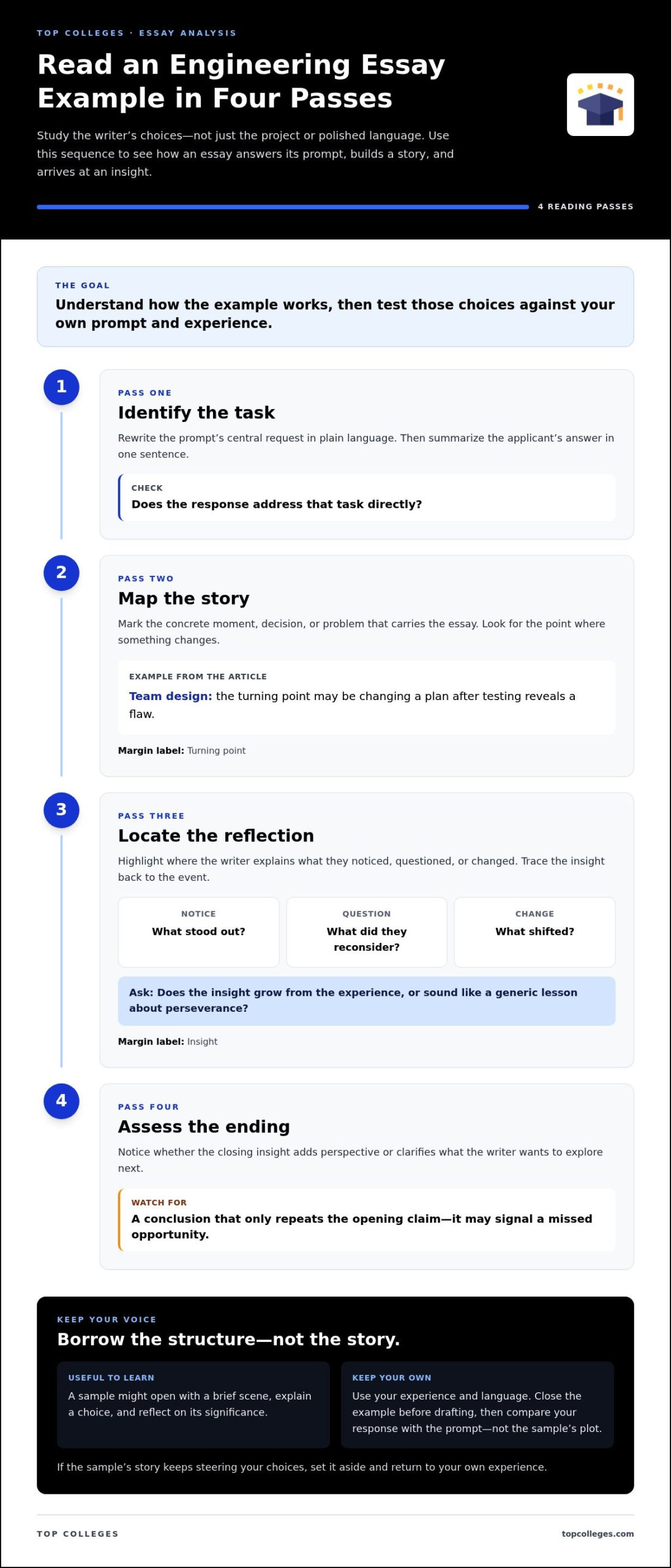
Annotate one example in four passes. This helps you notice how the essay works instead of simply absorbing its storyline or polished language.
- Identify the task. Rewrite the prompt’s central request in plain language, then summarize the applicant’s answer in one sentence. Does the response address that task directly?
- Map the story. Mark the concrete moment, decision, or problem that carries the essay. In a hypothetical team-design story, for example, the turning point might be when the writer changes a plan after testing reveals a flaw.
- Locate the reflection. Highlight where the writer explains what they noticed, questioned, or changed. Does the insight grow from the event, or does it sound like a generic lesson about perseverance?
- Assess the ending. Does the closing insight add perspective or clarify what the writer wants to explore next? A conclusion that only repeats the opening claim may signal a missed opportunity.
Use brief margin labels such as evidence, turning point, and insight. Then check the specificity: could these details belong to almost any applicant, or do they help you picture this writer’s particular decisions? If a sample discusses a college, distinguish researched reasons for fit from praise that could apply anywhere. A reference to ABET accreditation for engineering programs needs a clear connection to the writer’s own academic priorities to carry meaning.
How to learn from an example while keeping your voice
Borrow an observation about structure, not someone else’s language. You might notice that a sample opens with a brief scene, explains a choice, and reflects on its significance. That’s a useful craft insight. The sample’s exact phrases, project, and personal details aren’t yours to adopt. To create distance, close the example before drafting and work from your own notes.
Start with questions such as: What happened? What did I decide? What changed in my understanding? Draft freely, then compare your response with the prompt, not with the sample’s plot. If the sample’s story keeps steering your choices, set it aside and return to your own experience. Reviewing a response alongside other supplemental essay examples for engineering programs can reveal different structural options, but your evidence and voice must remain your own.
Before revising, check that each paragraph serves the prompt and that the ending adds a genuine insight. A broader application review can also help clarify how your essays fit together. Personalized college admissions counseling can support that work as part of an overall application strategy.
Which engineering essay examples fit your prompt and intended field?
The most useful example is the one that matches what your prompt asks you to do, not simply one with the same intended major. A “why this program?” response needs evidence of academic fit; a challenge response calls for a different kind of reflection. Use the comparison below to identify what a strong example might demonstrate, then confirm the exact prompt wording and word limit in the institution’s official application materials. Prompt formats vary, and no college is assumed to use every type.
Match common prompt types to the right kind of example
When comparing supplemental essay examples for engineering programs, identify the prompt’s purpose before choosing a story. Your evidence should support that purpose, and your reflection should explain what the experience means to you.
| Prompt purpose | Useful evidence | Reflection to look for |
|---|---|---|
| Why this program? | A specific academic interest linked to a verified course, research opportunity, or program feature. | Why that opportunity fits the questions you hope to explore, rather than simply sounding impressive. |
| Why engineering? | A question that led you to investigate, test, build, code, or revise something. | How the process developed your curiosity or changed how you approach a problem. |
| Challenge | A setback, constraint, or unexpected result and the choices you made in response. | What you learned through adapting, including what didn’t work or what you would do differently. |
| Community contribution | A moment when you listened, collaborated, or responded to a need shared by others. | How other people’s perspectives shaped your contribution and what you’d bring to a campus community. |
These categories can overlap, but don’t force one story into every prompt. For a program-fit response, name institutional opportunities only after verifying them, then explain why they connect to your aims. Broader questions about engineering’s role in addressing human needs can be informed by the National Academy of Engineering, but your essay still needs to show your own perspective rather than borrow an organization’s language.
Use engineering discipline examples without forcing a label
Different experiences can reveal relevant thinking: debugging code, observing how people use a space, repairing an object, conducting a small investigation, or coordinating a collaborative design. The key is your reasoning, not access to advanced equipment or formal research. A single experience may spark interest across disciplines; you don’t need to claim certainty before exploring them.
Discipline-specific details should sharpen an authentic interest, not create a specialty narrative you can’t support. Avoid relying on stereotypes, such as assuming a mechanical engineering applicant must love machines or a computer engineering applicant must have built software since childhood. Choose examples that reflect what you actually noticed and did. Ask whether each technical detail clarifies your interest or merely adds a label. That distinction helps you select examples for relevance, not prestige.
How to turn an engineering experience into an original supplemental essay
A strong draft doesn’t need to cover an entire project or prove that you already think like a professional engineer. It needs to reveal how you responded to a specific question, obstacle, or opportunity, then connect that experience to the prompt. Start with the moment your thinking shifted and build outward from there.
Find the story inside a project, class, or everyday problem
Review your experiences for a small episode with a clear decision. Perhaps a group prototype kept tipping, a line of code produced an unexpected result, or a household object was difficult for someone to use. The project’s scale matters less than the moment you noticed something and chose what to do next. Ordinary experiences can be compelling when they show genuine curiosity or initiative.
Before drafting, make brief notes:
- Situation: What were you trying to do, and what wasn’t working?
- Question: What did you notice or want to understand?
- Decision: What did you change, test, or ask someone else?
- Insight: What did the experience reveal about how you approach problems?
Choose one episode instead of summarizing every activity or phase. Include enough concrete detail for a reader to follow the situation without specialist knowledge. For example, explain what the prototype needed to do and why it failed before naming a technical component. Your decisions and reasoning should carry the story, not an inventory of tools, specifications, and results.
Revise for insight, precision, and prompt alignment
Open with a real moment, not a broad announcement such as “I have always wanted to be an engineer.” Then check each paragraph against the prompt. Does it answer the question, show a relevant choice, or deepen the reader’s understanding of your motivation? Replace unexplained technical terms with a short explanation or the consequence of the issue. Let reflection clarify why the experience mattered instead of adding a generic lesson at the end.
Use supplemental essay examples for engineering programs to notice craft choices, but keep your draft grounded in your own experience. A useful revision pass includes these checks:
- Does the essay address the exact prompt and stay within the institution’s stated word limit?
- Are the details precise, relevant, and understandable to a general reader?
- Does the reflection explain what you learned, questioned, or want to explore?
- Have you removed borrowed-sounding phrases and unsupported claims about the college?
Finally, consider how this supplement complements your personal statement and activity list. For a broader approach to shaping an application narrative, connect this focused revision process with architecting the best college essays.
Personalized college admissions counseling can also help you refine your application strategy and develop a portfolio of essays that answers each prompt. Explore personalized college admissions counseling.
Make your engineering supplements part of a coherent application strategy
An engineering supplement should add a new dimension to your application, not repeat the personal statement or retell an activity-list entry. Think of the full application as a portfolio: each component should contribute distinct evidence while reinforcing a credible picture of your interests, judgment, and readiness to learn. A project might appear in more than one place, but each reference should serve a different purpose. The activity list can record your role; an essay can examine a decision or question that mattered to you.
That coordination takes deliberate review. Supplemental essay examples for engineering programs can help you recognize possible approaches, but your final set of responses should reflect your own experiences and answer each college’s particular prompts. College admissions counseling can also help you see how individual essays contribute to the application as a whole.
Check how each supplement contributes to the application
Lay out your prompts, drafts, personal statement, and activity list together. For every essay, write down the quality, interest, or experience it adds. Then look across the set for useful variety: one response might reveal how you pursue a technical question, while another shows how you collaborate or respond to a community need. The goal isn’t to present unrelated versions of yourself. It’s to give each response a distinct role in a consistent story.
- Spot repeated anecdotes. If the same project appears in several essays, decide where it best answers the prompt. Use a different experience elsewhere when it adds meaningful evidence.
- Check factual consistency. Confirm that descriptions of your responsibilities, interests, and intended field align with your activities and other application materials.
- Review voice and focus. Read the essays in sequence. Do they sound like the same applicant while answering their prompts directly?
A portfolio review can also reveal gaps. If every response describes accomplishments but none shows how you think, reconsider which experiences or details you’ve chosen. If two essays make the same point, revise one to offer a different perspective rather than adding detail for its own sake.
Know when strategic essay feedback can help
Feedback may be useful if you’re unsure which moment can sustain a focused essay, find a prompt difficult to interpret, or can’t tell whether multiple drafts repeat one another. Effective guidance should sharpen your choices, not take authorship away. Personalized college admissions counseling can place essay development within a broader application strategy that includes portfolio development and personal statement review. You remain responsible for the experiences, perspective, and final voice on the page.
Use feedback to ask better questions: Does this response answer the prompt? Is the reflection clear? Does it add something distinct to the application? The aim is a more precise expression of your own story, not a borrowed one or a promise of a particular outcome. Top Colleges is led by educational consultant Steven Roy Goodman.
Learn more about Top Colleges.
Shape the next draft around your own perspective
Your next step doesn’t need to be a perfect essay. Choose one prompt, identify the experience you want to explore, and write down what you noticed, decided, and came to understand. Let supplemental essay examples for engineering programs help you recognize effective craft, but use your own questions and perspective to guide the draft. That’s how an application can communicate not only what you’ve done, but how you might approach what comes next.
If you’d benefit from a strategic sounding board, personalized college admissions counseling led by Steven Roy Goodman can help you clarify your story in the context of the full application. Counseling includes application strategy, portfolio development, and personal statement review, with the aim of refining your perspective while keeping the work authentically yours.
Trust the details only you can provide. A thoughtful, original response is a strong next step toward presenting your engineering interests with clarity and confidence.
Frequently Asked Questions
How many supplemental essays do engineering applicants usually need to write?
There’s no standard number; requirements vary by college and application cycle. One school may ask for a brief academic-interest response, while another may include several questions or no engineering-specific supplement. Create a school-by-school tracker with each prompt, deadline, word or character limit, and status. Check the current official application materials before drafting, since requirements can change and one college’s instructions don’t determine another’s.
What makes an engineering supplemental essay stand out?
A memorable response answers the exact question and uses a concrete detail to make the applicant’s thinking visible. For example, supplemental essay examples for engineering programs may show how a writer responds to an unexpected test result, but the valuable insight is the reasoning behind the next step. Technical sophistication isn’t essential. Specific reflection about what you learned and how it shapes your goals is more effective than broad claims or an activity inventory.
Can I use the same engineering essay for multiple colleges?
You can build more than one response around the same central experience, but adapt each draft to its prompt. Place the college’s name and question beside the essay and ask: would this response still make sense unchanged for another institution? If so, a why-this-program essay may need more verified detail. Recheck the prompt and limit each time, and remove any school reference that doesn’t belong.
Do I need to have completed an engineering project to write a strong supplement?
No. An essay can grow from noticing how a process works, pursuing a question in class, or coordinating a task with others. For instance, a student who helps organize a club event might reflect on how they identified a bottleneck and adjusted the plan. The key is to explain the observation, choice, and takeaway honestly. Don’t inflate an experience or present routine participation as engineering research.
Should engineering supplemental essays include technical vocabulary?
Use technical terms only if they help explain what happened. If you include an acronym or specialized concept, briefly define it or show its practical consequence so a reader outside your field can follow the story. For example, explain what a measurement helped you decide rather than naming a tool without context. If removing a term makes the point clearer without losing accuracy, leave it out.
How long should an engineering supplemental essay be?
Follow the current limit for the individual prompt, whether it’s expressed in words or characters. These limits aren’t universal, so verify the application instructions before you revise. Draft with enough room to explain the relevant context and your response, then cut repetition and details that don’t serve the question. If no limit appears, follow the platform’s directions and prioritize a complete, focused answer over an arbitrary length.
Is it acceptable to read admitted students’ engineering essay examples?
Yes, reading them can help you compare openings, pacing, and how writers handle different prompts. But an admitted applicant’s essay doesn’t prove that a particular topic or technique caused the admission decision. Samples may reflect different prompts and circumstances. Instead of searching for a winning formula, note one craft choice worth studying, then set the example aside. Draft from your own notes and check that every claim reflects your experience.