

Disclaimer
Content on this page of topcolleges.com is computer generated and therefore is not guaranteed to be 100 percent accurate about various aspects of the education sector. On balance, however, many students and families seek general information about high schools, colleges and universities, graduate programs, testing, education and career planning, and job placement before beginning one-on-one admissions counseling tailored to their specific needs.
Recent admissions data reveals that 28% of college admissions officers have visited an applicant’s social media profile. So, do colleges check social media accounts? Sometimes, but that doesn’t mean every applicant undergoes a routine online screening or that a post becomes an admissions scorecard.
It’s understandable to wonder whether an old joke, a public profile, or content you thought was deleted could be taken out of context. The practical response isn’t to panic or manufacture a polished online persona. It’s to understand what may be visible and present yourself thoughtfully.
This article explains how social media may enter the admissions process, what kinds of online content could raise concerns, and why private or deleted posts aren’t guaranteed to remain unseen. You’ll also find a focused way to review your public profiles and consider how they fit with the person and interests reflected in your application.
Key Takeaways
- Do colleges check social media accounts? Practices vary, so treat public posts as potentially visible rather than assuming every application receives a formal review.
- Private profiles aren’t the whole picture: tags, reposts, usernames, and content shared by others may also shape what appears online.
- Credible threats, harassment, and discriminatory conduct may raise concerns, but ordinary interests, humor, or opinions don’t automatically undermine an application.
- Use a focused review to search your name, inspect public profiles, revisit recent posts, and check tagged content before applying.
- If a post prompts a question, respond truthfully and briefly, providing relevant context without minimizing genuine concerns.
Do Colleges Check Social Media Accounts? The Realistic Answer
Yes, an admissions reader may come across public content, but social media review varies by institution. It is not a universal or guaranteed step in every application review. A post might surface incidentally, or a college might have its own process for considering online material. Neither possibility means every applicant’s profiles are routinely searched.
The question “do colleges check social media accounts” has no single answer for every school. Admissions practices differ, and finding a post does not automatically determine an admissions outcome. If a reader encounters something, its meaning may depend on the content and surrounding context, not simply on the fact that it exists.
That variation reflects the broader admissions landscape. The overview of College admissions in the United States describes a system involving institutions with their own processes. Applicants shouldn’t assume one screening standard applies everywhere.
What does it mean when a college checks social media?
A review can mean viewing material that’s publicly available online. It doesn’t necessarily mean requesting account access or passwords, or conducting a formal search of every profile. A reader might encounter a post while looking into information connected to an application. That is different from a college-wide screening procedure, and practices may vary by institution and applicant situation.
Does every college review every applicant’s profiles?
No available evidence establishes that every college checks every applicant’s social media. Don’t treat the possibility of review as proof of routine screening, or assume a particular post will reach an admissions reader. If a college publishes guidance about social media or application review, consult its current policy. A school’s own published information is more relevant than broad assumptions about what colleges do.
Separate three questions: what a school could see, what its readers actually review, and how they might consider anything they find. A public post can be accessible without being sought out. Even if it is noticed, that doesn’t tell you how it will be interpreted. An ordinary post may offer little insight into an applicant, while content that raises a credible concern may prompt closer attention.
The sensible position is neither “no one will ever see it” nor “every post is being scrutinized.” Treat public-facing content as potentially viewable while recognizing that review practices vary. If you’re concerned about a specific college, look for its published admissions guidance rather than relying on rumors or assuming one school’s approach applies to all.
How Colleges May Encounter Public Social Media Content
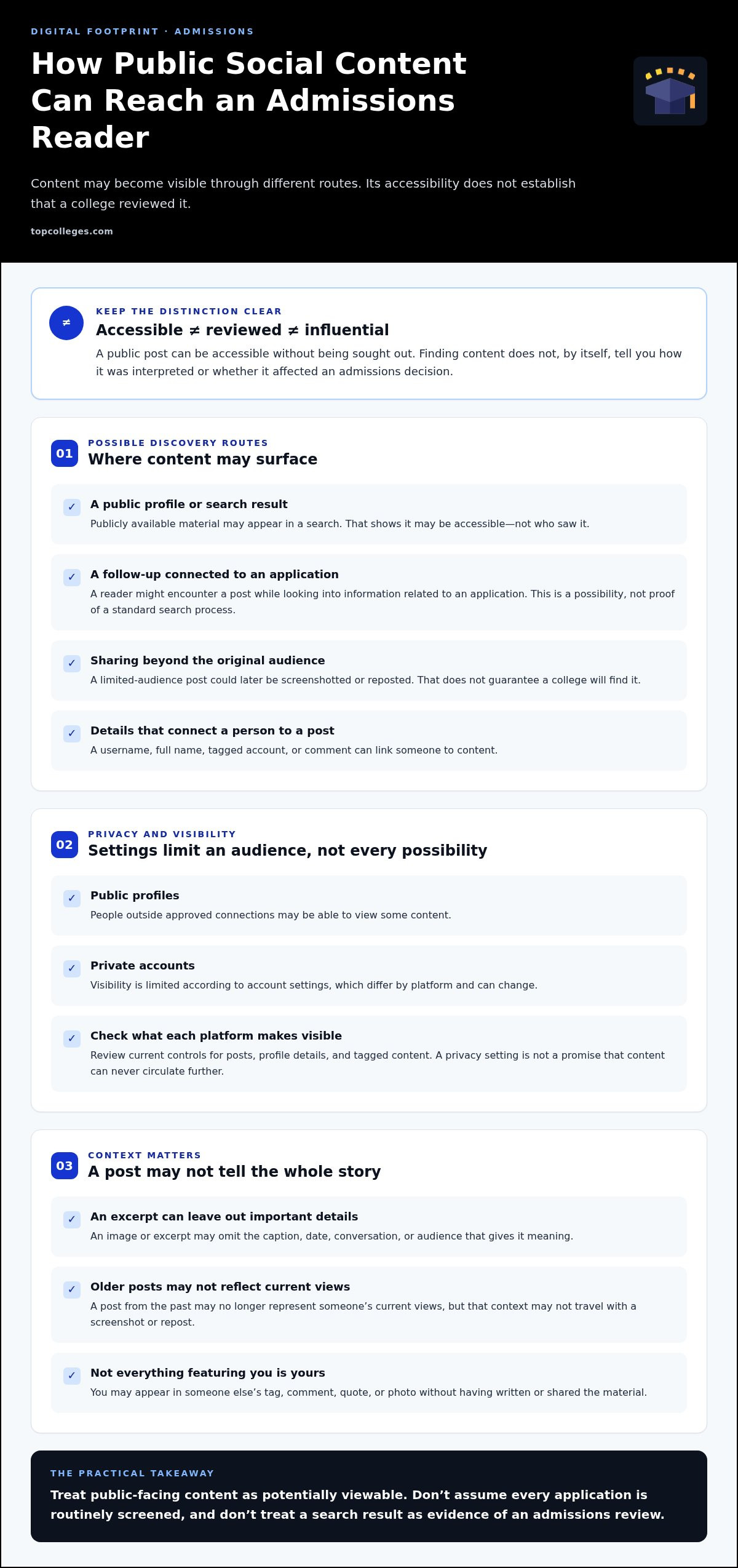
Online content can reach an admissions reader in different ways. A profile may appear in a search, someone else may share a post, or a reader may encounter it while following up on information connected to an application. These are possibilities, not proof of a standard search process. Whether colleges check social media accounts is separate from how discoverable a particular post may be.
Instagram, TikTok, and LinkedIn are examples of platforms where people share different material, from short videos and personal updates to professional interests. Their presence here doesn’t mean colleges routinely screen those platforms. Discoverability depends on what’s public, how it’s shared, and the details that connect a post to its author.
Public visibility does not prove that an admissions office reviewed a post. A search result or publicly viewable profile shows only that material may be accessible. It doesn’t confirm who saw it or whether it influenced an admissions decision.
Public profiles, private settings, and searchable posts
A public profile may let people outside your approved connections view some content. A private account generally limits visibility according to its settings, but audience controls differ by platform and can change. Review each platform’s current privacy controls to see who can view your posts, profile details, and tagged content. Don’t treat a privacy setting as a promise that content can never circulate further.
For example, a post shared with a limited audience might later be screenshotted or reposted. A username, full name, tagged account, or comment can also connect a person to a piece of content. None of these routes guarantees a college will find something. They illustrate why the original audience may not be the only one that sees it.
Why online context can be incomplete
A single image or excerpt may leave out the caption, date, conversation, or audience that gives it meaning. A joke between friends can look different without the exchange around it, and an older post may no longer reflect someone’s current views. Context matters, but it may not travel with a screenshot or repost.
Distinguish your own posts from material created by others. You might appear in a tag, be quoted in a comment, or be pictured in someone else’s post without having written or shared it. Search engines and social platforms can surface publicly available material, but their results aren’t a reliable record of what an admissions office reviewed or how it reached a decision.
A measured review can help you understand your online presence without assuming every result carries admissions significance. As you develop a coherent application, personalized college admissions counseling can help you think strategically about how different parts of your presentation fit together.
Which Social Media Posts Raise Concerns, and What Is Often Misunderstood?
Applicants often ask, “do colleges check social media accounts,” then worry that one imperfect post could define their candidacy. That fear overstates what any single post can tell a reader. Content that appears to show a credible threat, targeted harassment, discriminatory conduct, or apparent academic dishonesty may prompt questions. Interpretation depends on the details and broader context.
No single post can be described as an automatic admissions outcome without evidence. Be wary of online lists claiming that a particular joke, hobby, opinion, or photo will reliably help or hurt an application. Admissions decisions involve an overall review, and colleges may differ in how they handle information they encounter.
Content that may prompt closer questions
Consider the difference between a heated disagreement and repeated, targeted harassment, or between an exaggerated expression and a credible threat directed at someone. A post that appears to show cheating or misrepresenting academic work could also raise questions about judgment or honesty. These are examples of content that may deserve attention, not a definitive checklist of admissions rules or consequences.
Context can change what a post appears to communicate. Was it directed at a specific person? Is it part of a pattern or an isolated exchange? Is the content yours, or were you tagged in something someone else created? A reader may not have the full conversation, so don’t assume a post will be interpreted in the worst possible way or that its intent will be obvious.
Misconceptions about opinions, mistakes, and old posts
A lawful opinion, political view, unpopular position, or ordinary personal interest isn’t automatically equivalent to misconduct. Disagreement can be part of genuine expression, although the nature of the language and conduct still matters. Broad claims that all political posts, strong opinions, or humor will damage an application aren’t a reliable basis for deciding what to do with your accounts.
Older content can be harder to interpret when its original conversation or date is missing. Time may provide useful context, but it doesn’t guarantee a post will be ignored or understood as harmless. Review it thoughtfully rather than treating every old post as permanently damaging or automatically irrelevant.
The answer isn’t to erase every awkward moment or create an artificial online persona. Ask whether the content is genuinely harmful, misleading, or inconsistent with how you want to represent yourself now. If it needs correction, consider an appropriate, honest response. If it’s merely imperfect or open to interpretation, pause before reacting. A coherent application comes from an authentic account of your interests and choices, not a performance designed to look flawless.
Review Your Digital Footprint Before Applying to College
Wondering “do colleges check social media accounts” can make a quick review feel high-stakes. Keep it measured. The goal isn’t to erase your personality or predict what an admissions reader might think. It’s to understand what someone could readily see, correct anything inaccurate or unintentionally exposed, and make deliberate choices about what you share.
Set aside time to check your public-facing presence from an outside perspective. Platform controls change, so review the current privacy settings on each account rather than relying on old instructions or assuming one setting covers everything.
A calm, practical social media self-audit
Work through these steps in order. Look for material that is public or connected to your name, then decide whether anything needs attention. A search result is a starting point, not a complete record of your online presence.
- Search your name and common usernames. Use ordinary public search tools and try variations you’ve used online. Note what appears, but don’t assume a result means a college has seen it.
- Inspect your public profiles. Review profile photos, biographies, public posts, and comments. Check that details are accurate, and consider whether your profile reveals personal information you’d prefer to keep private.
- Review recent content. Read posts as a stranger might, while considering their original context. Check whether captions, images, or replies still represent what you intend to communicate.
- Check tags and shared material. Look at posts where others have tagged or mentioned you. If something appears without context, consider whether you can add context or adjust the tag’s visibility through the platform’s current controls.
Use what you find to make specific decisions, not to launch a sweeping clean-up. A privacy adjustment may be appropriate for personal information. A post may warrant an edit or clarification if that reflects your considered view.
What to do when a post needs attention
Pause before deleting, replying, or asking someone else to remove content. First establish what was posted, who shared it, when it appeared, and what surrounding conversation may be missing. If it’s inaccurate or no longer reflects your thinking, an authentic correction, update, or explanation may make more sense than a rushed reaction. Don’t create a false persona simply to appear flawless.
Thoughtful online self-presentation can support, rather than replace, the story told by your application. Consider whether your public interests and creative work sit naturally alongside your essays and other materials. A consistent application comes from honest reflection. College essay strategy and portfolio guidance can help you think about how those elements fit together.
For structured support as you shape your broader application strategy:
Handling Social Media Concerns in College Admissions
A genuine conduct concern calls for a different response from worry about ordinary personal content. An old photo, an unpopular opinion, or a post that feels awkward in hindsight isn’t automatically a crisis. If someone from a college asks about specific material, focus on what they’re asking rather than assuming every online detail requires an explanation.
Social media is one possible piece of context, not a substitute for the application as a whole. The question “do colleges check social media accounts” can feel consuming, but admissions decisions involve more than an isolated post. Your essays, activities, academic context, recommendations, and other application materials each help communicate who you are and what you bring.
How to explain a post honestly and proportionately
If asked about a post, make sure you understand the concern and the material being discussed. Then answer directly and truthfully. Explain relevant context without blaming others, speculating about what a reader thinks, or inventing an excuse. If your actions harmed someone, acknowledge that plainly and describe meaningful steps you’ve taken since. A concise response is often stronger than a long defense that avoids the central issue.
For example, you might clarify when a post was made and what the surrounding exchange involved, then recognize why the wording caused concern. Include only context that helps explain the situation. Don’t conceal facts or send unsolicited explanations to every college simply because you’re anxious. If a school hasn’t raised the issue, consider whether bringing it up is necessary before acting.
How admissions guidance can put the concern in perspective
It can be difficult to judge a post clearly when application pressure is high. Personalized college admissions counseling can help applicants consider a concern alongside essays, activities, academic context, and interview preparation, rather than letting one online detail dominate the entire strategy. That broader perspective can help you decide whether to prepare a response or focus on the rest of the application.
Top Colleges provides personalized guidance across the college application process, including portfolio development, personal statement review, and interview preparation. This support can help you decide what deserves attention, communicate clearly, and keep your application grounded in an authentic account of your strengths and experiences. It can’t guarantee an admissions outcome, but it can provide structure as you make decisions.
If you’d like personalized support as you develop your application strategy, explore college admissions guidance at your own pace.
Shape Your Next Step With Confidence
The question “do colleges check social media accounts” can’t be answered the same way for every school. Rather than letting uncertainty dictate your choices, use it as a prompt to make thoughtful decisions and keep your attention on the full story you want your application to tell.
Build that story with intention. Consider how your experiences, interests, and goals connect, and make sure your application reflects them honestly. A post doesn’t have to define you; your thoughtful actions and the broader context you provide matter too.
Personalized admissions counseling can bring structure to the process, from application strategy and portfolio development to personal statement review and interview preparation. With focused guidance, you can approach each part of your application as a connected expression of who you are, without trying to present an artificial version of yourself.
Move forward with perspective and purpose. Your application is an opportunity to present your genuine strengths and take the next step toward college with confidence.
Frequently Asked Questions
Can colleges see private social media accounts?
Private settings limit ordinary public visibility, but they can’t guarantee that content stays unseen or unshared. A college viewing a private profile is different from seeing a screenshot, repost, or material another person shares. For example, a friend could repost a photo beyond its original audience. Check each platform’s current controls, and choose settings based on your privacy preferences rather than guesses about admissions review.
Do colleges ask applicants for social media passwords?
Applicants shouldn’t assume that providing social media passwords is a standard admissions step. Viewing publicly available information is different from requesting account credentials, and practices may vary by institution or situation. Treat an unexpected request for sensitive login information cautiously. Before sharing credentials, contact the college’s official admissions office through a contact channel listed on its own website and ask whether the request is legitimate.
Can an old social media post affect a college application?
An old post could matter if it becomes visible and raises a relevant concern, but its age alone doesn’t determine its meaning or an admissions outcome. Its accuracy, surrounding conversation, and your broader record may all matter. Review older public content calmly, especially if it could be misunderstood without context. If you identify a genuine concern, consider how to address it honestly instead of automatically deleting everything.
Should I delete my social media before applying to college?
No, deleting every account isn’t a universal requirement, and it may not remove content already shared elsewhere. First review your public profiles, privacy settings, and tagged material so you can make deliberate choices. You may remove or update a post if that reflects your considered judgment, but avoid creating a misleading persona or deleting accounts out of panic. Responsible, authentic online behavior is a sounder goal than appearing flawless.
Do colleges Google applicants’ names during admissions?
Practices vary, and the available evidence doesn’t justify saying every college searches every applicant’s name. A search may surface public information, but seeing a result doesn’t show that an admissions reader viewed or used it. To understand what others might find, search your name alongside a username or activity you share publicly. If a college publishes guidance about online information or application review, use that as your reference.
Can social media affect athletic recruiting or scholarships?
Online conduct may be relevant in some recruiting or scholarship contexts, but expectations and review processes can differ among institutions, programs, and award types. Don’t assume every opportunity involves a social media review or that a particular post guarantees a consequence. Check official program guidance for stated expectations, and aim for a public presence that reflects responsible conduct without treating ordinary personal expression as automatically disqualifying.